
Install the app
How to install the app on iOS
Follow along with the video below to see how to install our site as a web app on your home screen.
Note: This feature may not be available in some browsers.
You are using an out of date browser. It may not display this or other websites correctly.
You should upgrade or use an alternative browser.
You should upgrade or use an alternative browser.
Tie rod/pitman arm clearance on a saginaw swap
- Thread starter jeepstar
- Start date



Ol Fogie
74 cj5 304, 1943 gpw, in moth balls,
- Joined
- Nov 24, 2019
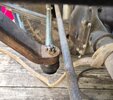
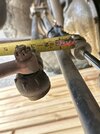
Did not think of that! pushing down will move the axle forward with the springs flatting out! very well could reduce the clearance with wheels pointing straight ahead where the clearance is the least.Put a bunch of weight on the front bumper and see what happens when you flatten out those springs.

cj2atruck
Member
- Joined
- Dec 12, 2020
When you turn, the tie rod will move backwards, so I think the only concern is when the axle hits the bump stop. Adding weight and maybe a ratchet strap should tell you if you are OK with your gap. If you can’t hit the bump stops, try removing your front shackles and lowing the jeep to the bump stops to give you an idea of the risk of hitting. Not as good as weight and straps, but you need some kind of test.

- Joined
- Jul 18, 2013
As one who is theoretical, but maybe not practical, it is possible to determine the maximum amount the axle with push forward as the spring compresses based on the shackle. The farthest forward the axle can push is when the shackles go flat/horizontal/90degrees. Just for helping think about it....if under normal resting conditions, the shackle is perfectly vertical (not ideal alignment - just makes the thought experiment easier), then the amount the axle can go forward is the same as the length of the shackle (eye to eye). IIRC, most OEM shackles for CJs are 2.75" long, so the most the axle can push forward is 2.75". Of course, if the shackle has better alignment with the forward/spring end in front of the frame mount eye, then whatever the forward positioning is (say the spring end is 1" in front of the frame mount), then that will reduce the amount the axle can move forward by that 1in amount - and in this example, the most the axle can push forward is 1.75".
Just because I like calculations....I think a lot of us like a shackle angle around 30 degrees from vertical (and its easy trig calc....sin30=1/2).....Basic trig says a 2.75" shackle at 30 degrees will have the bottom end 1.375" in front of the frame, leaving only 1.375" inches (2.75-1.375=1.375) that it will move forward as it rotates the remaining 60 degrees to horizontal. That would be the maximum the the axle can move forward with that set-up, assuming the frame is rigid etc. Of course, as we know there are a few secondary factors at play - such as frame flex etc - I would use that number as the absolute minimum for the spacing, and realistically would want additional space. The longer the shackle (and theoretically the associated spring would be long enough to accommodate), the more that axle can move forward. The more vertical the shackle is under rest conditions, the more the axle can more forward - due to the sine relationship, the axle will move forward the same amount from 0-30 degrees, as it will from 30-90 degrees.
Just because I like calculations....I think a lot of us like a shackle angle around 30 degrees from vertical (and its easy trig calc....sin30=1/2).....Basic trig says a 2.75" shackle at 30 degrees will have the bottom end 1.375" in front of the frame, leaving only 1.375" inches (2.75-1.375=1.375) that it will move forward as it rotates the remaining 60 degrees to horizontal. That would be the maximum the the axle can move forward with that set-up, assuming the frame is rigid etc. Of course, as we know there are a few secondary factors at play - such as frame flex etc - I would use that number as the absolute minimum for the spacing, and realistically would want additional space. The longer the shackle (and theoretically the associated spring would be long enough to accommodate), the more that axle can move forward. The more vertical the shackle is under rest conditions, the more the axle can more forward - due to the sine relationship, the axle will move forward the same amount from 0-30 degrees, as it will from 30-90 degrees.
- Joined
- Jul 18, 2013
You could also approach this from the spring length side of things.....Under resting conditions, measure the spring eye to eye distance (straight line). Then measure the length of the spring along the arc. When the springs go flat under compression, the eye to eye distance is at its max and is equal to the actual spring length. The difference in the two lengths is the amount the front end of the spring (and thus the axle) will move forward when the spring goes from resting to compressed.
when comparing this method to the shackle method above, it does bring up the concept of which aspect of the system is limiting the forward movement - the spring length or the shackle length. To protect the springs from damage, the spring needs to be able to go flat. That means in a well designed system, the true length of the spring should be less than the distance between the frame mounts plus the shackle length. In other words, when the spring goes flat, the shackle is probably not pushed all the way forward (to 90 degrees) and that means the prior shackle calculation has some 'cushion' built in to its calculation.
when comparing this method to the shackle method above, it does bring up the concept of which aspect of the system is limiting the forward movement - the spring length or the shackle length. To protect the springs from damage, the spring needs to be able to go flat. That means in a well designed system, the true length of the spring should be less than the distance between the frame mounts plus the shackle length. In other words, when the spring goes flat, the shackle is probably not pushed all the way forward (to 90 degrees) and that means the prior shackle calculation has some 'cushion' built in to its calculation.

ITLKSEZ
Watching a toddler play w/a loaded gun
- Joined
- Aug 13, 2015
I’d give it a little more if possible. It might not come in contact on every bump, but it could under bushing flex.
Also, ideally, you want your “normal driving” range of drag link travel to average out at parallel to the tie rod. If you start at parallel at rest, every bump you hit will take the drag link below the tie rod.
If you have 1” of upward axle travel in normal driving conditions, you’ll want the tie rod end at the pitman arm to be 1/2” above the tie rod. Picture a metronome. Balanced. If it’s too far one way or the other, the swing won’t be even and you’ll have bump steer.

- Joined
- Oct 23, 2007
If you do have a clearance issue with the drag link but not the pitman arm you could re-taper the pitman arm and knuckle so you can flip the draglink to the top.


- Joined
- Oct 25, 2006
As one who is theoretical, but maybe not practical, it is possible to determine the maximum amount the axle with push forward as the spring compresses based on the shackle. The farthest forward the axle can push is when the shackles go flat/horizontal/90degrees. Just for helping think about it....if under normal resting conditions, the shackle is perfectly vertical (not ideal alignment - just makes the thought experiment easier), then the amount the axle can go forward is the same as the length of the shackle (eye to eye). IIRC, most OEM shackles for CJs are 2.75" long, so the most the axle can push forward is 2.75". Of course, if the shackle has better alignment with the forward/spring end in front of the frame mount eye, then whatever the forward positioning is (say the spring end is 1" in front of the frame mount), then that will reduce the amount the axle can move forward by that 1in amount - and in this example, the most the axle can push forward is 1.75".
Just because I like calculations....I think a lot of us like a shackle angle around 30 degrees from vertical (and its easy trig calc....sin30=1/2).....Basic trig says a 2.75" shackle at 30 degrees will have the bottom end 1.375" in front of the frame, leaving only 1.375" inches (2.75-1.375=1.375) that it will move forward as it rotates the remaining 60 degrees to horizontal. That would be the maximum the the axle can move forward with that set-up, assuming the frame is rigid etc. Of course, as we know there are a few secondary factors at play - such as frame flex etc - I would use that number as the absolute minimum for the spacing, and realistically would want additional space. The longer the shackle (and theoretically the associated spring would be long enough to accommodate), the more that axle can move forward. The more vertical the shackle is under rest conditions, the more the axle can more forward - due to the sine relationship, the axle will move forward the same amount from 0-30 degrees, as it will from 30-90 degrees.
ARRRGGGGGGGHHHHH I've got paralysis by analysis!!!!!!You could also approach this from the spring length side of things.....Under resting conditions, measure the spring eye to eye distance (straight line). Then measure the length of the spring along the arc. When the springs go flat under compression, the eye to eye distance is at its max and is equal to the actual spring length. The difference in the two lengths is the amount the front end of the spring (and thus the axle) will move forward when the spring goes from resting to compressed.
when comparing this method to the shackle method above, it does bring up the concept of which aspect of the system is limiting the forward movement - the spring length or the shackle length. To protect the springs from damage, the spring needs to be able to go flat. That means in a well designed system, the true length of the spring should be less than the distance between the frame mounts plus the shackle length. In other words, when the spring goes flat, the shackle is probably not pushed all the way forward (to 90 degrees) and that means the prior shackle calculation has some 'cushion' built in to its calculation.
Ol Fogie
74 cj5 304, 1943 gpw, in moth balls,
- Joined
- Nov 24, 2019
I was kinda thinking the same thing with me being trig challenged and all.ARRRGGGGGGGHHHHH I've got paralysis by analysis!!!!!!