• Registration trouble? Please use the "Contact Us" link at the bottom right corner of the page and your issue will be resolved.

The roughest riding cj.

Dana44

Member
Joined
Aug 30, 2026
I own a '48 cj2a, a '66 cj5 with 11 pack springs and a '71 cj5 with unknown aftermarket springs. The 1971 is lifted maybe 2".

The '71 is easily the harshest ride of the 3 on any uneven surface. Tires, springs, lift. IDK. But when my lower back is sore from farm jeeping 5 miles I know its not my mind. I can experiment with air pressure. But want to understand better what influences ride. Not sure yet whats been changed on the '71 from original. Does lifting change the ride?

What surprises me is the 1966 with its thick spring packs rides nicer. I will post pics of the spring packs, the tires and the seats later today. I know this subject has been beat to death but hope to get some feedback from experience regarding stock-ish springs.
I know a jeep rides like, well, a jeep. Not Princess and the Pea here, expecting the moon.
 
BDS leaf springs are night and day from any other leaf springs that I have personal experience with. For the better
 
The rate of the springs (deflection with a measured force) will certainly affect the ride. You can imagine that the springs might have a high arch and a very high rate for initial deflection, then the rate would decrease as the springs deflect more and more. I suspect the flat springs like used on Chevy 4x4 trucks are there because of the ride. Jeep also used a monoleaf design on the rear of the Jeepster Commando, reputed to ride nice.

If you want to explore this topic, I suggest the Google AI with some carefully worded questions -

There is a lot of engineering that goes into the design of such components.

I'd also mention that, as well as tire pressure, the sidewall stiffness of the tires makes a big difference in small shocks that get transfered to the chassis and driver. Jeep drivers have to choose between a more comfortable ride (2-ply polyester radial sidewalls) or greater resistance to damage (heavier multi-layer bias ply sidewalls).

You also need good seats. The Jeep factory buckets are comfortable IMO.

I have BDS springs on my CJ-6, and have no complaints. Kinda think they have a similar ride to what I remember of the factoy heavy duty suspension from the mid-70s. I also run big soft tires at low pressure.
 
My 1967 (built in Aug. 1966) has its original factory leaf springs. The ride is not harsh - maybe in part because the springs are 60 years old?

I just replaced a set of 15+ year old worn-out Monroe shocks with new Bilsteins, which firmed up the ride a good bit from what it was, but not to the point that it's at all uncomfortable.
 
Last edited:
Not sure yet what the lift is but rwo things stand out:

1) they tilted the front axle. Is that typical?

2) the springs suck. Riding today and paying attention its obvious there is little to no deflection when the jeep is level. The ride is very "choppy" and hard on the back.

I deflated the tires to show at least a little radial bulge. Running 15lbs. This helped on the rocks and stones. Not much for the harshness.

I wish I inew what aftermarket springs are on there so I could eliminate those when relacements are considered.
 
What do you mean, tilted?

Post some pictures of the springs and you might get a reply from someone that recognizes them.
 
“2) the springs suck. Riding today and paying attention its obvious there is little to no deflection when the jeep is level. The ride is very "choppy" and hard on the back”
If you haven’t already, might be worth it to verify the spring hanger bolts are not over tightened and restricting spring deflection.
 
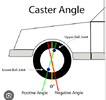
Will do. The front axle is turned forward. I guess they felt the lift was binding the universal joint too much by having increased the shafts angle of approach to the axle. Hope its as simple as over tight shackles.
 
You can't change the axle tilt without changing the steering geometry.
Tilting the pinion up reduces the caster angle and adversly affects straight-ahead tracking.
Not something one should mess with casually.

casterangle.png
 
The thickness of each leaf can have a huge effect. Thicker springs tend to have a harsher ride than thinner springs of the same overall pack hight.

Friction between the leafs can also be a factor. Each leaf needs to be able to easily slide across its neighbor(s) to function properly. I’ve seen whole packs back east that were fused together into one big brick from rust. Talk about harsh!
 
Regarding friction between the leaves, the mechanics at the Jeep dealership where I worked would oil springs.
Motor oil and solvent in a pump oiler.
Done routinely with maintenance service.
Another easy thing to try.
 
Will do. Looks like I need to figure what they did, then assess its merits. I will try the oil thing.
 
Not sure yet what the lift is but rwo things stand out:

1) they tilted the front axle. Is that typical?

2) the springs suck. Riding today and paying attention its obvious there is little to no deflection when the jeep is level. The ride is very "choppy" and hard on the back.

I deflated the tires to show at least a little radial bulge. Running 15lbs. This helped on the rocks and stones. Not much for the harshness.

I wish I inew what aftermarket springs are on there so I could eliminate those when relacements are considered.
Regarding radial bulge, I did the chalk test with my CJ anti determine the correct tire pressure and it made a noticeable difference in ride quality.
 
Also take a look at what kind of bushings are in your lift springs, rubber or urethane. With the stock rubber bushings you tighten the shackles hard to the bushings center sleeve and the motion of the bushing is through the rubber portion twisting between the inner and outer sleeve. Most urethane bushings are designed to have the shackle not as tight and it is the bolt in the sleeve where the motion is. If you have the bolts tightened to factory specs on urethane bushings it can be really hard for the shackles to move, making the ride stiffer.

Tim
 
Back
Top Bottom